Nevington War Museum
  • Nevington
    • Nevington and Environs
    • Nevington Wish List
    • The Museums Collection
  • Nevington News
  • National Collections
  • Timeline for War
  • The Catalogue of Weapons
Picture
Picture

Germany - Fieseler Aircraft

Picture

Fieseler Aircraft

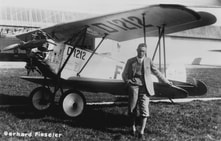
  • • F1 Tigerscwalbe - Acrobatic sportsplane (1930)
    This aircraft was built as a single-seat Raab-Katzenstein RK-26 Tigerschwalbe (Tiger Swallow) and was used by Gerhard Fieseler as an aerobatic demonstration aircraft. n 1930 Fieseler started his own company and refurbished the RK-26 into a two-seater and redesignated it Fieseler F.1. See also http://www.secretprojects.co.uk/forum/index.php/topic,11929.msg115499.html#msg115499
  • Fieseler Fi 2 (F2 Tiger, acrobatic sportsplane, 1932 • F2 Tiger - Acrobatic sportsplane (1932)
    The Fieseler F2 Tiger was a German single-seat aerobatic biplane which was flown to victory in the 1934 World Aerobatics Competition (WAC) by its designer/builder. The F2 Tiger itself would form the basis for later planes, including the Fieseler F5. Later designated Fi 2. 
  • • F3 Wesp - Flying Wing (1932)
    A competition delta-wing aircraft built by Gerhard Fieseler ito take part in the Europarundflug 1932. The design had the backing of the Haus Bergmann cigarette company. The new type had two motors in tandem with two crew in a covered cockpit sitting between them. The flying wing was chosen for the best placement of the rear engine. Which drove two British seven-cylinder Pobjoy Niagara R  radial engines , each with 75/85 hp. For the construction Fieseler of the three prototype examples he made use of Dr. Alexander Lippisch who was very experienced in the field of  flying wings. Because of the Europarundflug competition rules, the  wing was also to be foldable. 
  • • F4 - Touring Aircraft (1932)
    The Fieseler F 4 was designed, built and flown as a two-seat sports and touring aircraft in the Fieseler aircraft. Gerhard Fieseler was not satisfied despite good performance of the machine and stopped the activities prior to the start of production. 
  • Fieseler Fi 5 (F-5) acrobatic sportsplane + trainer, 1933 • F5 - Acrobatic Sportsplane & Trainer (1933)
    The F 5 was a low-wing tandem two-seat monoplane which retained the fabric-covered steel-tube fuselage of the earlier Fieseler F 4 but introduced a new two-spar cantilever wing. It had a fixed conventional landing gear with a tail-skid and the tandem open-cockpit were fitted with dual-controls. Behind the rear seat was a large luggage locker, the top decking at the rear could be removed to carry a spare propeller or skis. More than 29 built. Later re-designated Fi 5.
  • • F6 - Sportsplane Project (1933)
    Modified F 5 aircraft fitted with a uprated Hirth HM.60R engine.
     
    • F5R - Acrobatic Sportsplane (1934)
    Modified F 5 aircraft fitted with a revised wing, registration D-EBIX allocated.
  • Fi 97, competition and touring monoplane, 1934  • Fi 97 - Competition & tourer (1934) 
    The Fieseler Fi 97 was a single-engine 1930s German four-seat cabin touring and competition monoplane aircraft. Following the success of their two-seat tourer/trainer the Fieseler F5, Fieseler were encouraged by the RLMto develop a four-seat version specially to take part in the European touring plane championship Challenge 1934. Designed by Kurt Arnolt, it was a mixed-construction low-wing cantilever monoplane with a conventional tail unit. The fuselage had a fabric-covered steel tubing frame. The wing structure was wood and was covered with fabric and plywood. The wings were able to be folded aft for storage or ground transport. The tailskid undercarriage was fixed. The pilot and three passengers had an enclosed cabin. Five examples completed, three aircraft were fitted with the Hirth HM 8U, 250 hp inverted V8 engine, and two used the Argus As 17A, 225 hp inverted 6-cylinder inline engine. Both engines are air-cooled. The plane had STOL capabilities and the most significant design aspect was the wing's high-lift devices to enable the aircraft to be flown at low speeds. 
  • Fieseler Fi 98, biplane fighter, 1936  • Fi 98 - Dive bomber (1935)
    Biplane fighter and dive-bomber, three prototypes built only.
  • Fi 99, sport aircraft,  • Fi 99 Jungtiger - Light utility (1938)
    A sports aircraft prototype, produced by Fieseler company. The aircraft was a low-wing two-seat aircraft with an enclosed cabin. It was powered by a Hirth HM 506 A engine, producing 160 hp (119 kW).
  • Fieseler Fi 103 (V-1), pilotless bomber or flying bomb  • Fi 103 (V-1) - Unmanned Flying Bomb (1942)
    The V-1 pulse-jet was developed at Peenemünde Army Research Centre by the German Luftwaffe during the Second World War. During initial development it was known by the codename "Cherry Stone". The Fi 103 was also known as FZG 76 (FZG = Flak-Zielgerät = Anti-Aircraft Gun Targeting Device; misleading designation assigned for deception of the Allies), and as V-1 Vergeltungswaffe (Vengeance Weapon) number one. The designation was assigned by the German propaganda machine. 
  • Fi 103 Reichenberg, piloted version of V-1  • Fi 103R Reichenberg - Piloted Suicide Aircraft
    The Fieseler Fi 103R, code-named Reichenberg, was a late-World War II German manned version of the V-1 flying bomb produced for attacks in which the pilot was likely to be killed (as with the Japanese Ohka rocket-powered suicide anti-ship missile) or at best to parachute down at the attack site, which were to be carried out by the "Leonidas Squadron", Group V of the Luftwaffe's Kampfgeschwader 200. The V-1 was transformed into the Reichenberg by adding a small, cramped cockpit at the point of the fuselage that was immediately ahead of the pulsejet's intake, where the standard V-1's compressed-air cylinders were fitted. The cockpit had basic flight instruments and a plywood bucket seat. The single-piece canopy incorporated an armoured front panel and opened to the side to allow entry. The two displaced compressed-air cylinders were replaced by a single one, fitted in the rear in the space which normally accommodated the V-1's autopilot. The wings were fitted with hardened edges to cut the cables of barrage balloons. The aircfaft was to be taken to its target be Heinkel He.111.
• Fi 103R-I - Experimental Glider 
The basic single-seat unpowered glider.
 
• Fi 103R-II - Experimental Glider
Had a second cockpit fitted where the warhead would normally be. Unpowered glider
 
• Fi 103R-III - Twin-seat Pulse-Jet Flying Bomb
A two seater, powered with a pulsejet.

• Fi 103R-IV - Pulse-Jet Flying Bomb
The standard powered operational model. By October 1944 about 175 R-IVs were ready for action.
 
• Fi 103R-V - Twin-seat Pulse-Jet Trainer
Powered trainer for the He.162 (shorter nose)
 
• Fi 104 - Space Rocket Fighter Project (1944)
The Fieseler Fi-104 has been noted as a space fighter, developed from the knowledge gained with the Fi 103. They knew that Germany needed a space fighter if it was to be able to defend its holdings in orbit, and they also knew that it was going to take time to come up with something properly built. General consensus that this was probably work of fiction. See also http://www.secretprojects.co.uk/forum/index.php/topic,17115.msg218323.html#msg218323
  • Fi 156 Storch (Stork), STOL reconnaissance aircraft  • Fi 156 F - Counter insurgency Aircraft (1942)
    Counter insurgency version. Identical to the C-3 with machine guns in side windows and bomb-racks/smoke laying. (produced in 1942)
     
    • Fi 156 P - Counter insurgency Aircraft (1942)
    Counter insurgency version. Identical to the C-3 with machine guns in side windows and bomb-racks/smoke laying. (produced in 1942)
     
    • Fi 156 U - Anti-Submarine Warfare (1940) 
    Anti-submarine version. Identical to the C-3 with depth charge. (produced in 1940)
     
    • Fi 156 K-1 - Reconnaissance Aircraft (1940)
    Export version of the C-1 (for Sweden).
  • Fi 157, unmanned anti-aircraft target drone  • Fi 157 - Unmanned Anti-aircraft Target Drone (1937)
    The Fieseler Fi 157 was an unsuccessful attempt at developing a radio-controlled, full-sized anti-aircraft target drone for training. The Fi 158 was based on work done on this design. Prototypes completed only.
  • Fi 158, research aircraft  • Fi 158 - Research Aircraft (1938)
    Developed from Fieseler Fi 157, the Fieseler Fi 158 was a wooden civilian high-speed research aircraft designed and built in Germany. Designed as a manned version of the Fi 157 radio-controlled drone, the Fi 158 was a low-winged monoplane, with retractable tailwheel undercarriage and twin fins and rudders, with the crew sat in tandem in an enclosed cabin. Prortotype only.
 
  • Fi 166, vertical launched jet fighter    Fi 166 - Vertically Launched Jet Fighter (1941)
    In the early 1940s, Erich Bachem, Fieseler's Aircraft's technical manager, developed two designs for a rocket-launched fighter that could reach high altitudes quicker than conventional fighters. See http://www.secretprojects.co.uk/forum/index.php/topic,10603.0/all.html
     
    • Fi 166 Höhenjäger I - Jet Fighter (1941)  
    Involved a straight-winged jet fighter powered by two Jumo 004 jet engines. It would be launched upright by liquid-fuel rockets. RLM considered this design as impractical.
     
    • Fi 166 Höhenjäger II - Jet Fighter (1941)  
    Erich Bachem undertook a re-design to produce the Fi 166 Höhenjäger II, this time it a two seat rocketplane with a restartable engine. Again the RLM considered this as impractical.
 
  • Fieseler Fi 167, ship-borne torpedo bomber + reconnaissance (biplane)
  • • Fi 167 - Ship-borne Torpedo bomber & Reconnaissance (1938)
    The Fieseler Fi 167 was a 1930s German biplane torpedo and reconnaissance bomber designed for use from the Graf Zeppelin class aircraft carriers under construction from 1936 to 1942. The aircraft exceeded by far all requirements, had excellent handling capabilities and could carry about twice the required weapons payload. Like the company's better known Fieseler Fi 156 Storch, the Fi 167 had surprising slow-speed capabilities; under the right conditions, the plane would be able to land almost vertically on a moving aircraft carrier. Two prototypes (Fi 167 V1 and V2) were built, followed by twelve pre-production models (Fi 167 A-0) which had only slight modifications from the prototypes. 
 
  • Fi 168, ground-attack aircraft  • Fi 168 - Ground-attack (1938)
    The Fieseler Fi 168 was a projected German communications and ground attack aircraft designed in 1938 by Frederik Kassel. The two-engine aircraft was a strut-braced high-wing monoplane with two tail-booms and a narrow fuselage pod carried by struts under the centre-section, and was designed to operate in areas featuring rough terrain, and boasted two rigidly mounted forward-facing machine guns. Existed in mock-up form only. See also http://www.secretprojects.co.uk/forum/index.php/topic,4718.msg229776.html#msg229776 and http://www.secretprojects.co.uk/forum/index.php/topic,17115.msg218323.html#msg218323
  • • Fi 169 - Experimental (1938)
    The Fi 169 was allocated by the RLM the code 8-169, but no details found, possibly not used.
     
    • Fi 203 - Manned pulse jet
    Twin hulled Fi-103 development, probably a fictional design.
  • Fi 253, sport aircraft,  • Fi 253 Spatz - Sports Aircraft (1939)
A light civilian aircraft, only six units were produced, however, due to the Second World War. Had may features of the Storch aircraft.
 
• Fi 256 - Reconnaissance Aircraft (1943)
A five seat civil version of the Fi 156 design; two were built by Morane-Saulnier.


  • Fieseler Fi 333 transport (concept)​  • Fi 333 - Large Transport 
    The Fieseler Fi 333 was a prototype transport aircraft developed by Fieseler, and backed by the Luftwaffe. The aircraft was to utilise detachable pods of varying sizes to carry cargo, a system that would allow a rapid turnaround on the ground.  The very tall braced undercarriage was made unretractable so that the fuselage would be able to take the strain of the heavy cargo. Three prototypes were built, but without the distinctive undercarriage.
 
  • Fieseler Skoda FiSK 199


Fieseler Projects

Proudly powered by Weebly